Building a Minimum Viable Product (MVP) is one of the most critical steps for any startup. The right MVP development partner can help you validate your idea faster, reduce risk, and avoid costly mistakes early on. On the other hand, choosing the wrong team often leads to delays, poor product decisions, and wasted budget.
With so many agencies offering MVP development services, it can be difficult to identify which ones truly understand startup needs – such as rapid validation, lean execution, and scalability from day one.
To make this decision easier, we’ve researched and selected the top MVP development companies for startups in 2026. This list includes agencies with proven experience in building and launching MVPs, strong product thinking, and a track record of helping founders go from idea to market efficiently.
Below, you’ll find a curated list of companies that specialize in different approaches – from fast, fixed-price MVPs to design-led product development and scalable engineering solutions.
Top MVP Development Companies to Build Your Startup in 2026
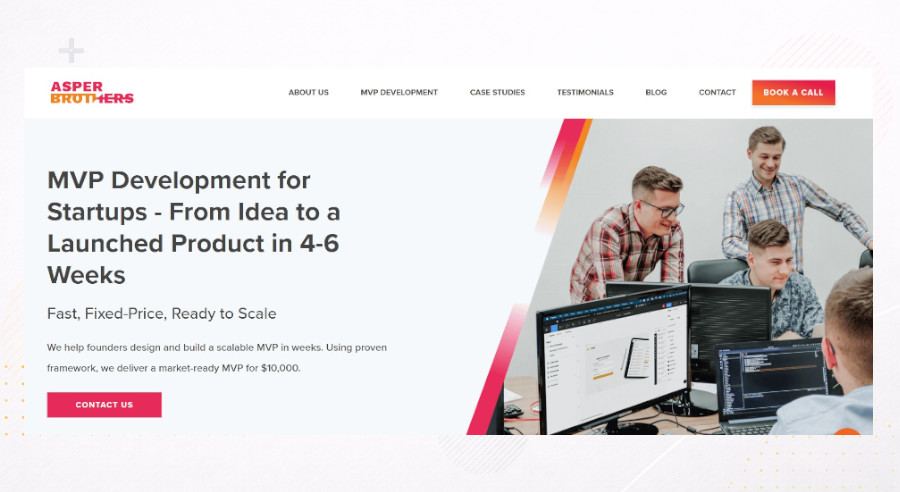
Asper Brothers is a startup-focused MVP development company that helps founders go from idea to launch in as little as 4–6 weeks using a structured, fixed-price model. The team combines product thinking with engineering, offering a proven 4-step MVP framework designed for fast validation and scalable growth. Founded by experienced entrepreneurs, they’ve delivered 60+ MVPs across multiple industries, focusing on speed, clarity, and long-term scalability.
Key strengths:
Fixed-price MVP delivery ($10k) with a clear 4–6 week timeline
Founder-first approach combining product strategy and development expertise
Scalable, custom-built solutions with full IP ownership and no vendor lock-in
Best for:
Early-stage founders who want to validate and launch an MVP quickly with predictable cost and timeline
thoughtbot is a product design and development consultancy that helps startups build MVPs through a structured, research-driven approach. Their process emphasizes product discovery, user research, and design sprints to validate ideas before development and reduce risk early. With a strong focus on iterative delivery and cross-functional collaboration, they guide founders from concept to scalable product using Lean and agile methodologies.
Key strengths:
Strong product discovery process with user research, validation, and MVP shaping sprints
Design-led development combining UX, strategy, and engineering in cross-functional teams
Proven Lean and agile methodology focused on rapid iteration and reducing product risk
Best for:
Funded startups that need a premium, research-driven partner for product design and MVP validation
Uptech is a product-focused software development company that helps startups design, build, and launch MVPs through a structured discovery and iterative development process. Their approach starts with understanding the business problem, defining core features, and rapidly validating ideas through prototyping and user testing. With a strong emphasis on product-market fit, Uptech builds scalable MVPs that can evolve into full-fledged products as startups grow.
Key strengths:
Strong product discovery phase including user research, goal setting, and validation before development
Iterative, agile MVP development focused on rapid prototyping, testing, and continuous improvement
Scalable architecture and engineering approach designed for long-term growth beyond MVP stage
Best for:
Startups that need a product-driven partner to validate ideas and build scalable MVPs with a structured process
Purrweb is a full-cycle product development company that helps startups rapidly build and launch MVPs for web and mobile applications. Their approach focuses on delivering core functionality quickly, enabling founders to validate ideas, test market demand, and iterate based on user feedback. With strong expertise in cross-platform development and UX-driven design, they emphasize speed, cost-efficiency, and scalability from the early stages.
Key strengths:
Rapid MVP development focused on core features to reduce time-to-market and costs
UX-driven approach with user journey mapping and validation before and during development
Strong cross-platform expertise (React Native, Flutter) enabling faster delivery with a single codebase
Best for:
Startups that want to quickly launch and validate a product with a strong balance of speed, UX, and cost-efficiency
F22 Labs is a startup-focused product development studio that helps founders build MVPs through a lean, agile approach focused on rapid prototyping and fast validation. They deliver end-to-end MVP development—from idea and design to deployment—while emphasizing clean code and a scalable technical foundation. With experience across web, mobile, and AI products, F22 Labs positions itself as a long-term technology partner for startups moving from concept to growth.
Key strengths:
Lean, agile MVP development enabling rapid prototyping, iteration, and validation
End-to-end product development from strategy and design to launch
Strong engineering focus with clean code and scalable architecture for future growth
Best for:
Startups looking for a cost-efficient, fast-moving MVP partner with strong engineering fundamentals
Upsilon is a product-focused development studio that helps early-stage startups build and launch MVPs within a structured, fast-paced process. Their approach centers on taking founders from idea to a working product in as little as three months, with a strong emphasis on validation, fundraising readiness, and product-market fit. Acting as a long-term tech partner, they combine discovery, design, and engineering to deliver scalable products and support startups beyond the MVP stage.
Key strengths:
Fast MVP delivery (around 3 months) with a focus on validation and investor readiness
Product-centered approach covering discovery, prototyping, and full-cycle development
Strong startup focus with experience helping clients raise funding and scale products
Best for:
Early-stage startups that need a reliable tech partner to quickly validate ideas and prepare for fundraising
Altar.io is a product and MVP development company founded by ex-startup founders, focused on helping entrepreneurs validate ideas and build successful products through a structured, user-centric approach. Their process emphasizes product discovery, defining value propositions, and validating assumptions before development to reduce risk and increase chances of success. Acting as a co-founder-like partner, they combine strategy, UX/UI design, and engineering to deliver lean, scalable MVPs.
Key strengths:
Strong founder-led approach with deep startup experience and co-founder-level collaboration
Structured MVP process focused on validation, user stories, and reducing risk before development
Emphasis on lean product development and Build-Measure-Learn cycles to achieve product-market fit
Best for:
Founders who want a strategic, hands-on partner to validate ideas and build a product with strong product-market fit focus
Wavespace is a global UI/UX design and MVP development agency focused on helping startups and SaaS companies turn ideas into user-friendly digital products. Their approach centers on creating intuitive user experiences, validating product concepts through design, and delivering scalable MVPs that can evolve with business growth. With a strong emphasis on design quality and usability, they position MVP development as a combination of strategy, UX, and rapid execution.
Key strengths:
Strong UX/UI design expertise focused on building intuitive, user-centered MVPs
End-to-end MVP support including design, prototyping, and scalable product development
Experience working with startups and SaaS products across multiple industries and global markets
Best for:
Startups that prioritize design quality and user experience when building and validating MVPs
SumatoSoft is a full-cycle software development company that helps startups design, build, and launch MVPs with a strong focus on business goals and long-term scalability. Their approach goes beyond development, supporting founders through idea validation, product discovery, and post-launch growth with analytics and roadmap planning. With an emphasis on transparency and partnership, they position themselves as a long-term technical advisor helping startups evolve from MVP to full-scale product.
Key strengths:
End-to-end MVP support including idea validation, prototyping, development, and post-launch optimization
Strong focus on business-driven development and aligning technology with product goals
Experience building scalable, complex systems with modern tech stacks and agile methodologies
Best for:
Startups building complex or data-driven products that require a scalable and technically robust MVP foundation
Bamboo Agile is a full-cycle software development company that supports startups and enterprises in building MVPs through a structured, consulting-led approach. Their process includes innovation workshops, product discovery, and rapid prototyping to define core features and validate ideas before development. With a strong focus on scalability and robust architecture, they design MVPs that can evolve into full products without the need for re-engineering.
Key strengths:
Structured MVP process including innovation workshops, discovery, and low-fidelity prototyping
Strong engineering focus on building scalable, production-ready systems from day one
Extensive experience across industries with complex, high-load and custom software solutions
Best for:
Startups building technically complex or scalable products that require a strong engineering foundation from the MVP stage
How to Choose an MVP Development Company?
Choosing the right MVP development partner depends on your startup’s stage, budget, and product complexity. While all companies in this list offer strong capabilities, they differ in their approach, speed, and specialization.
Here are the key factors to consider when making your decision:
1. Product Discovery and Validation Process
A strong MVP partner should help you refine your idea before writing code. Look for companies that offer discovery workshops, user research, or prototyping. This ensures you’re building the right product — not just building fast.
2. Speed of Delivery
Time-to-market is critical for startups. Some companies specialize in rapid MVP delivery (even within weeks), while others focus on deeper product design and longer timelines. Choose based on how quickly you need to validate your idea.
3. Startup Experience
Not all development agencies understand the realities of early-stage startups. Look for teams that have experience working with founders, raising funding, or iterating on early products. This often translates into better product decisions.
4. Technical Scalability
Your MVP should be built with future growth in mind. Even if you’re starting small, the architecture should allow you to scale without rebuilding everything from scratch.
5. Communication and Collaboration
You’re not just hiring developers — you’re choosing a partner. Clear communication, transparency, and a collaborative approach are essential, especially in fast-moving startup environments.
6. Pricing Model and Flexibility
Different companies offer different pricing models — fixed-price MVPs, time & material, or dedicated teams. Choose the one that aligns with your budget and risk tolerance.
FAQ – MVP Development
1. What is MVP development?
MVP development is the process of building a simplified version of a product with only its core features. The goal is to quickly validate a business idea, gather user feedback, and iterate before investing in a full-scale product.
2. How much does it cost to build an MVP?
The cost of MVP development typically ranges from $10,000 to $100,000+, depending on complexity, features, and the development team. Simpler MVPs or no-code solutions can be built faster and cheaper, while custom products with advanced functionality require a larger budget.
3. How long does it take to develop an MVP?
An MVP usually takes between 4 weeks and 6 months to build. Fast MVP approaches (e.g., no-code or fixed-scope builds) can be delivered in a few weeks, while more complex products with custom development take several months.
4. What should be included in an MVP?
An MVP should include only the core features necessary to solve the main user problem. It should be functional enough to test the idea in the market, but not overloaded with additional features that can be added later based on feedback.
5. How do I choose the right MVP development company?
Choose a company that understands startups, offers a clear development process, and aligns with your goals in terms of speed, budget, and scalability. Look for experience in product discovery, strong communication, and the ability to support your product beyond the initial MVP launch.
Summary
Building an MVP is not just about launching a product quickly — it’s about making the right decisions early and setting a strong foundation for future growth. The companies featured in this listing represent different approaches to MVP development, from rapid, validation-focused builds to design-led and highly scalable solutions. Choosing the right partner depends on your specific goals, whether that’s speed, product strategy, user experience, or technical complexity.
Ultimately, the best MVP development company is the one that aligns with your vision, understands the challenges of building a startup, and can support you beyond the initial launch. By working with an experienced, product-focused team, you increase your chances of building something users actually want – and turning your idea into a successful, scalable business.
Mariusz is a Head of SEO with over 15 years of experience in the industry. He specializes in strategic planning, content optimization, and technical SEO. Mariusz leads and oversees SEO projects, ensuring each initiative is aligned with client goals and delivers measurable results.
Share
Scalable MVPs for Ambitious Startups
A robust tech stack, intuitive UI, and seamless functionality—all built to scale.
Get to market quickly with an MVP designed for real-world validation and long-term success.