Building a Minimum Viable Product is one of the most critical stages in the life of a startup. It’s the moment when an abstract idea becomes a tangible product that real users can interact with. For founders, this phase is filled with high expectations, limited budgets, time pressure, and a significant level of uncertainty. One of the key tools that helps navigate this complexity and reduce risk is the use of user stories.
User stories may sound simple, but they play a foundational role in shaping the scope, functionality, and success of an MVP. They connect business goals with real user needs, guide product design and development, and ensure that teams focus on what truly delivers value.
In this article, we’ll explore what user stories are in the context of MVP development, why they are so important, how they differ from traditional specifications, how to write and prioritize them effectively, and how they support both short-term MVP validation and long-term product growth.
What Are User Stories in the Context of an MVP?
At their core, user stories are short, simple descriptions of a feature told from the perspective of the end user. Instead of focusing on technical details or system requirements, they describe what a user wants to achieve and why it matters.
The most commonly used format is:
As a [type of user], I want [a goal], so that [a benefit].
For example:
As a first-time user, I want to sign up using my Google account so that I can onboard quickly without creating a new password.
In the context of an MVP, user stories are not about documenting every imaginable feature. They are about capturing the smallest set of user needs that allow you to test your core business assumptions. Each user story represents a hypothesis: if we build this functionality, it will solve a specific user problem and create value.
Rather than asking, “What features should our product have?”, user stories force a more fundamental question: “What does our user want to achieve, and why?”
This shift in perspective is crucial for early-stage products, where every development decision should directly support learning, validation, and value creation.
The Role of User Stories in the MVP Development Process
MVP development is by nature iterative and experimental. Founders rarely have perfect information at the beginning. Assumptions about users, markets, pricing, and behavior must be tested as quickly and cheaply as possible. User stories play a central role in this process by acting as:
A translation layer between vision and execution
Founders often start with a broad product vision: solve a problem, disrupt an industry, improve a process. User stories translate that vision into small, concrete pieces of deliverable functionality that development teams can implement.
A scope-control mechanism
One of the most common MVP mistakes is building too much. By defining the product through user stories, teams can select only those stories that are essential for validating core assumptions, keeping the MVP lean and focused.
A learning tool
Each user story represents a testable assumption about user behavior. When users interact with the MVP, their behavior validates or invalidates those assumptions, generating real insights for the next iteration.
A shared language for cross-functional teams
User stories create a common understanding between founders, designers, developers, and stakeholders. Everyone discusses the product in terms of user value, not abstract features or isolated technical components.
In short, user stories become the backbone of the MVP: they define what gets built, why it gets built, and what success looks like for each piece of functionality.
User stories are often where the real product thinking begins. In our experience, they are the moment when a founder’s vision meets real user needs and becomes something a team can actually build, test, and improve. Paul JackowskiCEO, ASPER BROTHERSLet's Build Your MVP
User Stories vs. Traditional Functional Specifications
Many founders – especially those with experience in corporate or enterprise environments – are familiar with traditional functional specification documents. These are often long, detailed, and written in technical or semi-technical language. While they have their place in certain types of projects, they are usually ill-suited for early-stage MVP development.
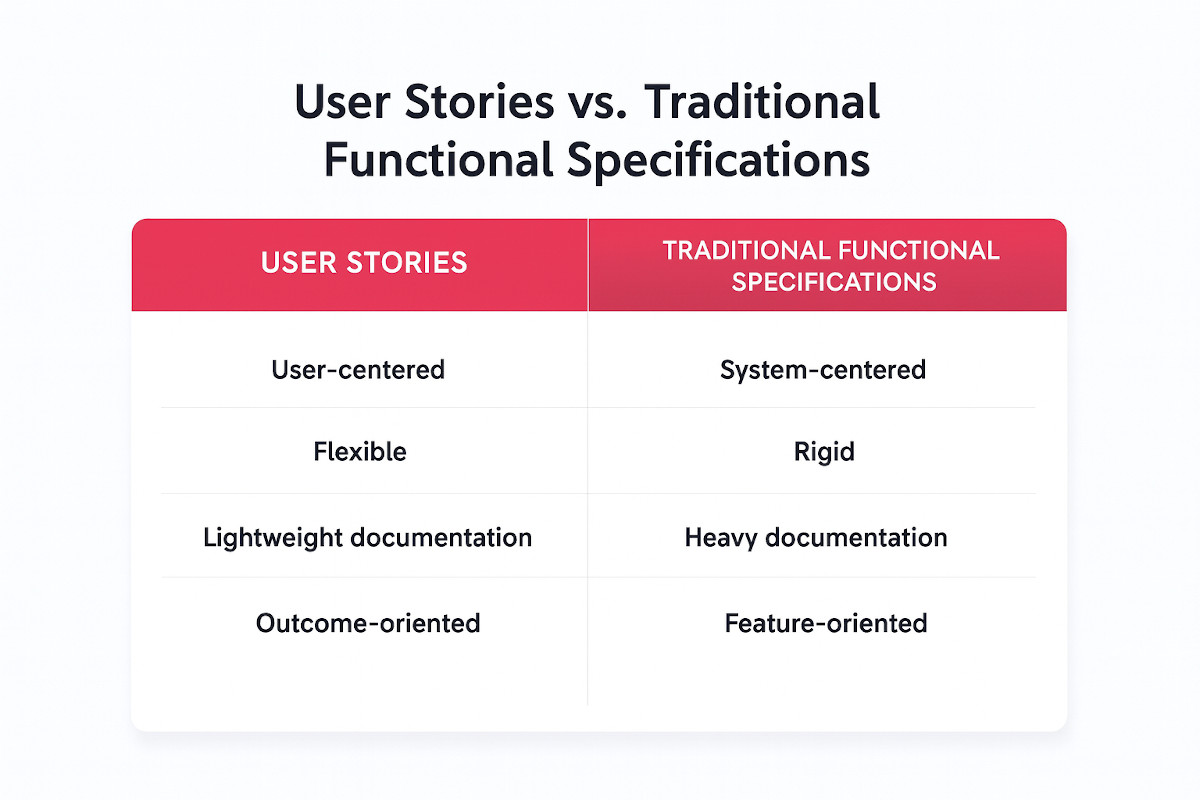
Here are the key differences between the two approaches:
1. User-centered vs. system-centered
Traditional specifications focus on what the system must do. User stories focus on what the user wants to achieve. This subtle difference has a major impact on product quality and relevance.
2. Flexible vs. rigid
User stories are designed to evolve as new insights emerge. Traditional specs aim for completeness upfront, which is difficult—and often counterproductive—when assumptions are still being tested.
3. Lightweight vs. heavy documentation
An MVP thrives on speed and adaptability. User stories provide just enough structure to enable development without slowing teams down with excessive documentation.
4. Outcome-oriented vs. feature-oriented
User stories emphasize outcomes and benefits. Specifications often emphasize features and technical constraints, which can lead teams to lose sight of why something is being built in the first place.
For MVPs, where uncertainty is high and learning is the primary goal, user stories offer a far better framework for defining product scope and direction.
The Structure of a Good User Story
Although user stories are intentionally simple, writing them well requires discipline and clarity of thinking. A good user story answers three fundamental questions:
Who is the user?
What do they want to do?
Why does it matter to them?
This is achieved through the standard structure:
As a [user], I want [goal], so that [benefit].
However, a user story is incomplete without acceptance criteria. These define the conditions that must be met for the story to be considered “done.” Acceptance criteria remove ambiguity and align expectations between all parties involved.
For example:
User Story: As a registered user, I want to reset my password so that I can regain access if I forget it.
Acceptance Criteria:
The user can request a password reset from the login screen.
The system sends a secure reset link via email.
The link expires after a defined period of time.
The user can set a new password that meets security requirements.
In an MVP context, acceptance criteria should be clear but not over-engineered. The goal is to ensure shared understanding, not to define enterprise-level edge cases at an early stage.
Good user stories are:
Focused on a single user goal
Independent of other stories where possible
Valuable from a user’s perspective
Small enough to be delivered in a short cycle
Testable through clear acceptance criteria
Prioritizing User Stories for an MVP
One of the most difficult decisions founders face is determining what not to build. You will always have more ideas than time or resources. This is where user story prioritization becomes critical.
In an MVP, not all user stories are equal. Some are essential for validating the product’s core value proposition. Others are merely supportive or “nice to have.”
Does this story directly support the core problem your MVP is trying to solve? Does it contribute to revenue generation, activation, retention, or validation of a key assumption?
2. User Impact
How strongly does this story affect the user’s ability to achieve their main goal? If removed, would the MVP still make sense?
3. Risk Reduction
Some stories reduce uncertainty more than others. For example, implementing a critical onboarding step may quickly reveal whether users understand the product at all.
4. Effort and Complexity
High-value, low-effort stories are usually prioritized first. Costly, complex stories that don’t significantly increase validation power are often postponed.
Popular prioritization frameworks such as MoSCoW (Must-have, Should-have, Could-have, Won’t-have), value-vs-effort matrices, or simple scoring models can help structure these decisions.
The key principle is this: Your MVP should include only the user stories that are strictly necessary to test your core business hypothesis.
Everything else can—and usually should—wait.
User Stories as a Communication Tool Between Founders, Designers, and Developers
One of the less obvious but extremely powerful benefits of user stories is their role in communication. MVP development typically involves people from very different backgrounds: founders with business or domain expertise, designers focused on user experience, and developers focused on technical implementation.
Misalignment between these groups is one of the most common causes of:
Scope creep
Misunderstood requirements
Rework and delays
Products that technically work but fail from a user perspective
User stories create a shared narrative that everyone can align around. Instead of discussing abstract features like “advanced filtering” or “dashboard optimization,” teams discuss concrete user intentions:
Who is the user?
What problem are they trying to solve?
What outcome do they expect?
This shared language:
Reduces misunderstandings
Makes design decisions more consistent
Helps developers understand the why behind the what
Keeps business goals and user needs tightly connected
For founders, this also provides a powerful way to remain actively involved in product decisions without micromanaging technical implementation. By validating and refining user stories, founders directly shape the product’s direction at a strategic level.
How User Stories Support Scaling After the MVP
Many founders think of user stories as a tool only for early product development. In reality, well-structured user stories remain valuable far beyond the MVP phase.
When your MVP gains traction and you move toward scaling, you face new challenges:
Growing feature sets
Increasing technical complexity
Larger teams
More diverse user groups
If your initial user stories were created with clarity and discipline, they form the foundation of a scalable product backlog. This offers several long-term benefits:
1. Continuity of Product Vision
Early user stories capture the original logic behind key product decisions. As the product grows, they serve as documentation of why certain features exist in the first place.
2. Easier Onboarding of New Team Members
New designers, developers, or product managers can quickly understand the product by reviewing user stories instead of decoding complex technical documentation.
3. Structured Expansion
Scaling often involves adding new user types, use cases, and revenue models. Existing user stories provide a framework for systematically expanding functionality without losing focus.
4. Better Roadmapping and Planning
Well-maintained user stories allow more realistic estimation, forecasting, and long-term planning. The product roadmap becomes a natural extension of the evolving backlog.
In this sense, user stories are not just a tactical MVP tool—they are a strategic asset that supports sustainable product growth.
FAQ – User Stories in MVP Development
1. Do I need user stories if I already have wireframes or UI designs?
Yes. Wireframes show how the product works, but user stories explain why specific features exist and what problem they solve for the user. Both complement each other.
2. How detailed should user stories be at the MVP stage?
They should be detailed enough to guide design and development, but not so detailed that they limit learning or slow down iteration. Simplicity and clarity are key.
3. Who should be involved in creating user stories?
Ideally: founders, product managers, UX designers, and developers. In many MVP processes, including those used by teams like Asper Brothers, user stories are created collaboratively to align business, design, and technology.
4. Can user stories change during MVP development?
Yes — and they often should. As real user feedback comes in, stories are refined, added, or removed based on what is learned.
5. What is the difference between a user story and a task?
A user story describes a user need and its value. A task is a technical step required to implement that story. One user story often consists of multiple development tasks.
Summary
User stories are far more than simple feature descriptions. In the context of MVP development, they are a foundational instrument that connects user needs, business goals, and technical execution into a coherent whole.
They help founders:
Clarify what value their product truly delivers
Keep the MVP focused and lean
Prioritize work based on real user impact and business risk
Align designers and developers around a shared understanding
Build a scalable foundation for future product growth
By shifting the conversation from “What should we build?” to “What does our user want to achieve and why?”, user stories fundamentally improve decision-making at every stage of product development.
For founders navigating the uncertainty of early-stage product creation, mastering user stories is not just a methodological choice—it is a strategic advantage that increases the chances of building something people genuinely need and want to use.
Mike Jackowski is the co-founder of Asper Brothers. He’s helped launch 60+ MVPs across five continents, turning early-stage ideas into real, working products. With roots in product development since 2007, he specializes in turning raw ideas into real apps fast, lean, and built for early validation.
Share
SUBSCRIBE our NEWSLETTER
Are you interested in news from the world of software development? Subscribe to our newsletter and receive a list of the most interesting information.
Fixed-Price MVP, No Surprises
We handle everything: intuitive UI, scalable backend, and seamless integrations.