In 2026, building a SaaS MVP is easier than ever. With AI-assisted development, mature cloud infrastructure, and a wide range of ready-to-use tools, the technical barriers to launching a product have significantly decreased. What used to take months can now often be done in a matter of weeks.
But this shift has changed the rules of the game.
The real challenge is no longer how quickly you can build an MVP, but whether that MVP will still be relevant a few months after launch.
AI models and autonomous agents are rapidly replacing entire categories of software. In many cases, they don’t just compete with SaaS products—they absorb their functionality.
Founders today are not just validating ideas. They are testing whether their product can survive in a world where AI is becoming the default interface for software.
What Has Changed in SaaS MVP Development in 2026
To build a resilient MVP, it’s important to understand how the landscape has evolved.
First, the way users interact with software has fundamentally changed. Instead of navigating multiple tools, users increasingly rely on AI agents that can execute tasks, retrieve information, and automate workflows through natural language. The interface is no longer a dashboard—it’s a conversation.
Second, while development has become faster, competition has increased at the same pace. Lower barriers to entry mean more products, faster iteration cycles, and shorter product lifespans. Speed alone is no longer a meaningful advantage—it’s expected.
Finally, features themselves have become commoditized. Today, AI can:
generate content
connect APIs
automate workflows
scaffold entire applications
This means that if your MVP is defined primarily by its features, it is likely already competing with AI—and losing.
In 2026, building a SaaS product is no longer just about delivering features quickly. What matters is working closely with founders to understand the real workflow behind the product and identify where AI can replace value—and where it can’t. That’s where truly defensible SaaS products are created. Paul JackowskiCEO, ASPER BROTHERSLet’s Build Your MVP
What AI Will Replace: The Fragile MVP
Many SaaS MVPs are fragile by design. They may work well technically, but they are built in categories that AI is rapidly taking over.
The most vulnerable products typically fall into a few patterns.
1. CRUD-Based Applications
Applications focused on basic data operations—creating, reading, updating, and deleting—are increasingly easy to replicate. These tools often act as thin layers over databases, which AI can now generate and manage with minimal effort.
2. Dashboards and Reporting Tools
Traditional dashboards are losing relevance. Instead of navigating predefined views, users can simply ask:
“What changed in our revenue this week?”
AI can generate insights on demand, making static dashboards less valuable.
3. Basic Automation Tools
Simple rule-based automation (e.g., “if this, then that”) is no longer enough. AI agents can understand context, adapt workflows, and handle exceptions—making rigid automation tools feel limited.
4. Content Generators
Tools for generating text, emails, or social media content now compete directly with foundational AI models. Without additional layers of value, they are difficult to differentiate.
If your MVP is just a user interface built on top of simple logic, AI can likely rebuild it faster than you can scale it.
What AI Cannot Replace (Yet)
Despite rapid progress, AI still has clear limitations—and these limitations define where strong SaaS products can exist.
Certain categories remain far more resilient.
Systems of Record
These are products that store critical data over time, such as CRMs, financial systems, or logistics platforms. Their value comes from accumulated data, consistency, and trust.
AI can interact with these systems, but it cannot easily replace them.
Deep Workflow Integration
Products that are embedded into daily operations are much harder to displace. They:
coordinate multiple steps
involve different stakeholders
handle real-world complexity
Replacing them would require changing how work is done—not just swapping tools.
Domain-Specific Software
AI is powerful, but still general-purpose. It struggles in areas that require:
deep domain knowledge
regulatory understanding
specialized workflows
Products that encode this knowledge create natural defensibility.
The AI-Proof SaaS MVP Framework
To build a SaaS MVP that can survive in 2026, you need to think about defensibility from day one.
A useful way to approach this is through five key principles.
1. Proprietary Data
Your product should capture or generate data that becomes more valuable over time. Ideally, this is data that:
is unique to your users
improves your system
cannot be easily replicated
Data is one of the strongest long-term advantages.
2. Workflow Depth
Instead of building isolated features, focus on workflows.
A strong MVP should:
support a complete process
reflect how users actually work
handle real-world scenarios
The deeper your product is embedded in a workflow, the harder it is to replace.
3. Switching Costs
If users can leave your product without friction, they eventually will.
Switching costs can come from:
accumulated data
integrations
process dependencies
Your MVP should start building these early.
4. Network Effects
Some products become more valuable as more people use them.
This can happen through:
collaboration
shared data
ecosystems or marketplaces
AI can replicate features, but it cannot easily recreate networks.
5. Outcome Ownership
Instead of offering a tool, focus on delivering a result.
Compare:
“We help you write emails”
vs.
“We manage your outbound communication”
The closer your product is to the final outcome, the harder it is to replace.
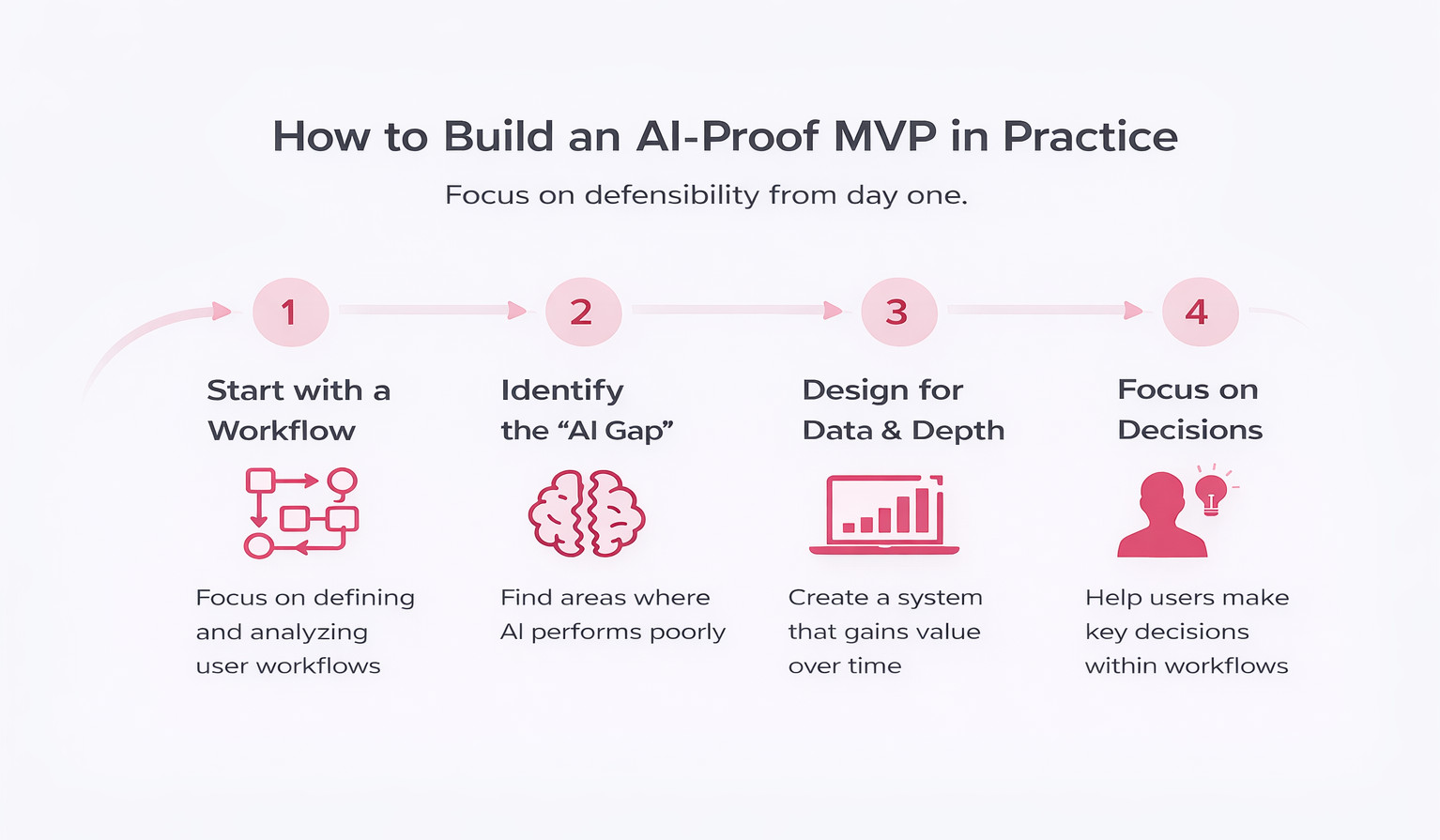
How to Build an AI-Proof MVP in Practice
Translating the idea of an AI-resistant product into a real MVP requires a shift in thinking. Instead of starting from features or inspiration, you need a structured approach that focuses on defensibility from day one. The process below breaks this down into four practical steps.
Step 1: Start With a Workflow, Not an Idea
Most founders begin with a product idea. In 2026, that’s no longer enough.
A more effective approach is to start with a specific workflow—a sequence of actions users take to achieve a goal. This could be onboarding a client, managing invoices, handling recruitment, or coordinating logistics.
To define this properly:
map out each step in the process
identify where users lose time or make mistakes
understand where decisions actually happen
Your MVP should not be “a tool for X,” but a solution that improves or owns a clearly defined workflow. This immediately makes it harder to replace.
Step 2: Identify the “AI Gap”
AI is powerful, but it is not perfect. It performs best in areas that are well-defined, repetitive, and based on widely available data.
Your goal is to find where it struggles.
Look for situations where:
context is complex or constantly changing
decisions require structured reasoning
data is fragmented or not easily accessible
human judgment still plays a key role
This “AI gap” is where your product should live. If your MVP operates entirely in areas where AI already performs well, it is likely to be replaced quickly.
Step 3: Design for Data and Depth
An AI-proof MVP is not just a product—it is a system that becomes more valuable over time.
From the very beginning, you should design your product to:
capture meaningful, structured data
support multi-step workflows
reflect real-world complexity
This means going beyond surface-level functionality. Instead of solving a single task, your MVP should start building a deeper layer of value through usage.
Over time, this creates:
better insights
stronger user dependency
a growing competitive advantage
Without this layer, your product remains easy to replicate.
Step 4: Focus on Decisions, Not Just Execution
AI excels at execution—writing, generating, automating. What it struggles with is structuring decisions within complex workflows.
Your MVP should therefore focus on:
guiding users through key decisions
organizing information in a meaningful way
reducing uncertainty in critical moments
Instead of simply doing things for the user, your product should help them decide what to do next—and why.
This shift—from execution to decision support—moves your product higher in the value chain and makes it significantly harder to replace.
In practice, an AI-proof MVP is not defined by what it does, but by where it sits in the workflow—and how deeply it becomes part of it.
MVP Scope in 2026: What to Include and What to Skip
In 2026, defining MVP scope is not just about building less—it’s about building something that won’t immediately be absorbed by AI.
A traditional MVP focuses on validating an idea. An AI-proof MVP must do more: it has to establish a layer of value that AI cannot easily replicate.
This changes what you include—and what you deliberately leave out.
What to Include
A strong AI-resistant MVP is not feature-rich, but it is strategically designed. It should focus on elements that build defensibility from the start.
1. A Core Workflow With Real-World Friction
Your MVP should not just “solve a task”—it should operate within a real, messy workflow.
This means:
multiple steps, not a single action
dependencies between actions
points where decisions are required
AI performs best in clean, well-defined tasks. It struggles in workflows that involve ambiguity, edge cases, and coordination.
If your MVP simplifies a real process, not just a task, it becomes harder to replace.
2. A Proprietary Data Capture Layer
An AI-proof product must start building unique data from day one.
This includes:
structured inputs from users
workflow-generated data (actions, decisions, outcomes)
contextual information tied to usage
The goal is not just to store data, but to create a dataset that:
improves over time
is specific to your domain
cannot be easily replicated by external models
Without proprietary data, your MVP has no long-term moat.
3. A Decision Layer (Not Just Execution)
Most MVPs focus on execution—doing things faster or cheaper.
In 2026, that’s not enough.
Your MVP should include a layer that:
structures decisions
guides users through complex steps
reduces uncertainty in key moments
Examples:
prioritization logic
recommendations based on context
structured inputs that lead to outcomes
AI is strong at execution. Products that own decision-making sit higher in the value chain.
4. Tight Integration Into a Specific Context
Generic tools are easy to replace. Contextual products are not.
Your MVP should be built for:
a specific user segment
a clearly defined environment
a narrow but deep use case
This can include:
integrations with existing tools
alignment with a specific workflow (e.g. recruiting, logistics, finance)
assumptions about how users operate
The more context your product has, the less interchangeable it becomes.
What to Skip
Just as important as what you build is what you avoid. Many common MVP elements actively reduce defensibility in an AI-driven landscape.
1. Generic Feature Layers
Avoid building features that can be easily replicated by AI, such as:
text generation
simple automations
basic CRUD interfaces
Unless these are deeply embedded in a workflow, they add little defensible value.
If a feature can be described in one sentence, AI can likely replicate it.
2. Polished UI as the Main Value
In the past, a well-designed interface could be a competitive advantage. In 2026, UI alone is not enough.
AI is increasingly:
generating interfaces
bypassing interfaces entirely (via agents)
A beautiful UI on top of shallow functionality is one of the easiest things to replace.
3. Broad, Horizontal Scope
Trying to serve too many use cases makes your product more generic—and easier to replace.
Avoid:
multi-industry positioning
wide feature sets
“platform” thinking too early
Depth in a narrow workflow is far more defensible than breadth across many.
4. Standalone “Tool” Positioning
Products that act as isolated tools are increasingly vulnerable.
Avoid building something that:
users “open and use occasionally”
is not connected to other systems
does not influence a broader process
In 2026, tools are replaced. Systems that are part of workflows survive.
In an AI-driven world, MVP scope is not about how much you build—but about whether what you build creates a layer of value that AI cannot easily absorb.
FAQ – Building a SaaS MVP in 2026
1. What does “AI-proof SaaS MVP” actually mean?
An AI-proof SaaS MVP is a product designed to stay relevant even as AI replaces simple tools. Instead of relying on easy-to-copy features, it focuses on things like proprietary data, workflows, and decision support—areas where AI struggles to compete.
2. Can AI replace SaaS products completely?
AI will not replace all SaaS products, but it is already replacing many simple ones. Tools based on basic features are most at risk, while products built around data and workflows are much harder to displace.
3. How do I know if my SaaS idea is vulnerable to AI?
If your product solves a simple task, relies on generic functionality, or does not build unique data, it is likely vulnerable. The more your product focuses on execution rather than workflows or decisions, the higher the risk.
4. Should I include AI features in my MVP?
AI can be valuable if it supports the core workflow or improves decision-making. However, adding AI alone does not make a product defensible—how it is used matters more than the fact that it is included.
5. How much does it cost to build a SaaS MVP in 2026?
A SaaS MVP can often be built in 4–6 weeks for around $10,000, but only with a well-defined scope. The key is focusing on a single workflow and avoiding unnecessary features that increase complexity without adding value.
Final Takeaways
Building a SaaS MVP in 2026 is no longer just about execution. It is about making the right decisions early.
To create a product that can survive in the age of AI:
build less, but with more intention
focus on workflows instead of isolated features
treat data as a core asset
aim for depth rather than breadth
AI will continue to reshape the software landscape. Many products will disappear as their functionality becomes absorbed into more general systems.
The products that endure will not be the fastest to build, but the hardest to replace.
And that is something that must be designed from the very first version of your MVP.
Mike Jackowski is the co-founder of Asper Brothers. He’s helped launch 60+ MVPs across five continents, turning early-stage ideas into real, working products. With roots in product development since 2007, he specializes in turning raw ideas into real apps fast, lean, and built for early validation.
Share
SUBSCRIBE our NEWSLETTER
Are you interested in news from the world of software development? Subscribe to our newsletter and receive a list of the most interesting information.
Build your MVP in 4–6 weeks for $10k
From idea to a market-ready product — fast, simple, and predictable. No hidden costs, no technical headaches.
Validate your concept and launch with a scalable foundation from day one.
The real estate sector, traditionally driven by human expertise and intuition, is now embracing the profound transformation brought about by Artificial...
Nowadays, artificial intelligence is becoming increasingly popular. The term refers to the implementation of human intelligence in machines designed to learn...